FEATURES
Heat Resistant — For peak temperatures up to 650°C and operating temperatures of 538°C.
Pure unmodified silicon resin and thermally stable pigments.
RECOMMENDED USES
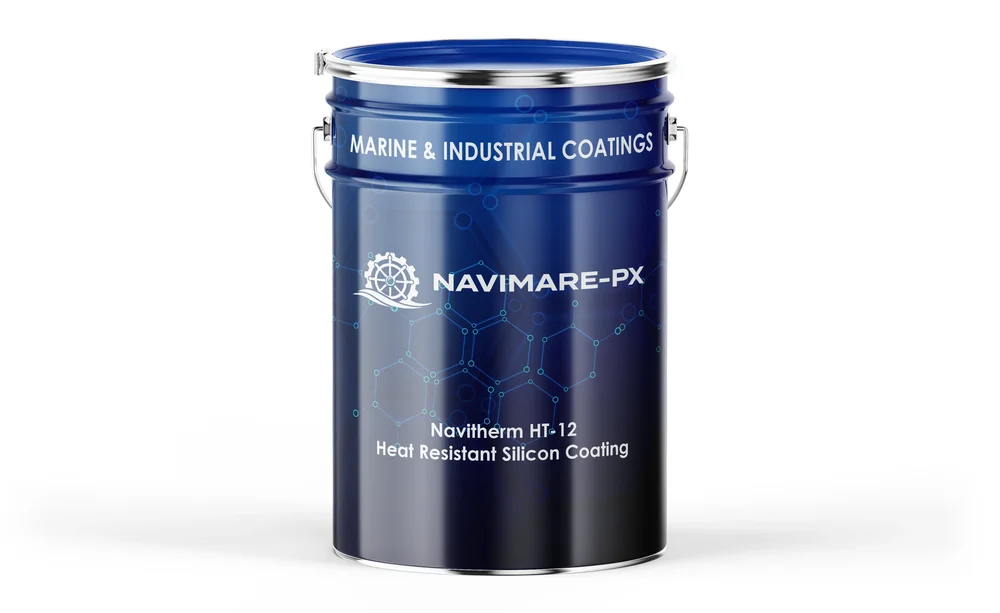
Exteriors of steel structures exposed to high temperatures, in chemical plants, marine structures, ships, power plants, oil production and refining plants. Navitherm HT-12 is a high performance, high temperature resistant coating. HT-12 can be used as a self-priming coating system over abrasive blast cleaned steel. HT-12 may also be applied over most zinc silicate primers, such as Navizinc. Service temperature must be at least 204°C.
- Stacks
- Boiler casings, breechings
- Furnaces, kilns, ovens
- Piping, pumps, manifolds
- Process vessels
- Stainless steel
SPECIFICATION DATA
| Coating Type |
: Silicon resin |
| Color |
: Aluminium RAL 9016 (640-S-9100), Red, Black, White |
| Density (at 20°C) / VOC |
: 1.15 Kg/Lt. / VOC: 62% by weight / 677 g/l |
| Packaging |
: 18.0 Lt (20 Kg). Single component. |
| Gloss |
: Semi-gloss |
| Flash Point / Temp. Resistance |
: 18°C / 538°C dry heat over steel; 400°C over zinc silicates |
| Thinner for cleaning |
: Navimar T-5 Thinner (thinning not normally recommended) |
| Shelf life |
: 1 year from shipment date when stored in unopened containers at 5–40°C |
| Volume Solid |
: 45% (ASTM D2697, modified) |
| Theoretical spreading rate |
: 18 m²/Lt. at 25 µm. Allow for application losses. |
| Application data |
: Apply 72–84 µm WFT to obtain 30–35 µm DFT. |
| Application |
: Conventional or airless spray |
| Curing |
: Bake cure at 232°C for 1 hour or allow to cure in operation. Full film properties are not obtained until heat cured. |
| Drying time |
: 20°C, 50% RH, 30 mic. DFT. Touch dry: 1 hour. Dry to handle: 2 hours. Min. overcoating time: 24 hours. |
Surface Preparation
All surfaces must be clean, dry and free of wax, grease, mould remover and other dirt. STEEL — Blast in accordance with Swedish Standard Sa 2½ (SIS 05 5900-1967 / ISO 8501-1 / SSPC SP-10). Blast to achieve a 25–40 µm profile. Remove abrasive residues and dust. Apply HT-12 as soon as possible after surface preparation to prevent contamination. Do not leave blasted steel uncoated overnight. ZINC SILICATE — Surface must be free of any foreign matter. Refer to application instructions for the zinc silicate for any other special top coating requirements.
Priming, Mixing, Thinning
HT-12 is a single-component material packaged in a 20 Lt can. Thinner/cleaner: T-5. (1) Flush equipment with T-5 before use. (2) Stir all material thoroughly before applying. (3) For conventional spray, thin only as needed with no more than 10% T-5. Thinning is normally not needed for airless spray. (4) Spray an even wet coat with parallel passes, overlapping each pass 50%, followed by a cross-spray pass at right angles. Give special attention to angles, corners, rough spots and edges to avoid pinholes and holidays. (5) Application at 56 µm WFT will normally provide 25 µm DFT. (6) Check thickness with a non-destructive dry film thickness gauge. NOTE: excessive application thickness may result in cracking and insufficient adhesion. (7) For touch-up, apply additional material; smaller areas may be brushed. Allow 1 hour at 21°C between full coats. (8) In confined areas, ventilate with clean air during application and drying until all solvents are removed. (9) Clean all equipment with T-5 immediately after use.
Application
Do not apply in direct sunlight to prevent premature drying. Apply by brush, roller or spray. AIRLESS SPRAY: Standard airless equipment (Graco, DeVilbiss, Nordson-Bede, Spee-Flo or similar) with 28:1 or higher pump ratio and a fluid tip 0.28–0.42 mm (0.011–0.017 inch) orifice. CONVENTIONAL SPRAY: Industrial equipment such as De Vilbiss MBC or JGA gun with 78 or 765 air cap and “E” fluid tip, or Binks No. 18 or 62 with 66 x 63 PB nozzle. Separate air and fluid pressure regulators and a mechanical pot agitator are recommended. A moisture and oil trap in the main air supply line is essential.
Precaution
Refer to material safety data sheet of the product. Additional safety information is available upon request. Minimum safety precautions in dealing with the paints are;
- Take precaution to avoid skin and eye contact (i.e. gloves, goggles, face mask, barrier creams, etc.)
- Provide adequate ventilation.
- If the product comes in contact with the skin, wash thoroughly with lukewarm water and soap or suitable industrial cleaner. If the eyes are contaminated flush with water (minimum 10 minutes) and obtain medical attention at once.
- Since these products contain flammable materials, keep away from sparks and open flames. No smoking should be permitted in the area.
- Observe all precautionary notices on containers.
Disclaimer
This is not a specification and all information is given in good faith. Since conditions of use are beyond the manufacturer’s control, information contained herein is without warranty, implied or otherwise, and final determination of the suitability of any information or material for the use contemplated, the manner of use and whether there is any infringement of patents is the sole responsibility of the user. Manufacturer does not assume any liability in connection with the use of the product relative to coverage, performance or injury. For application in special conditions, consult Navimare-PX for detailed recommendations.