FEATURES
- Formulated for application and cure underwater in fresh or salt water
- 100% Solids epoxy
- Excellent cathodic disbondment resistance
- Excellent water resistance
- Effective corrosion barrier
- Excellent chemical and solvent resistance
RECOMMENDED USES
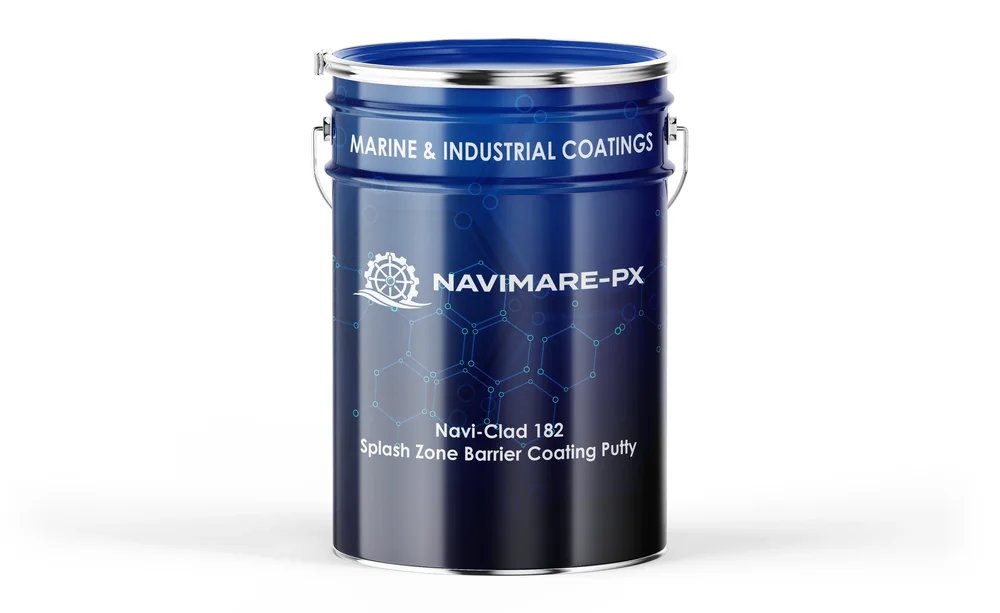
A special polyamide epoxy mastic for use on those areas of marine structures and pipelines which cannot be maintained effectively with conventional coatings or cathodic protection.
- Repair underwater pipes
- Repair underwater pilings and bracings
- Repair water line structures and retaining walls
Many years of service around the world confirm the effectiveness of this product as a corrosion barrier.
SPECIFICATION DATA
| Color |
: Aluminum Gray 182-K-2000 and other catalog numbers |
| Density (at 20°C) |
: dA=1.78 / dB=1.374 / (d A+B=1.60 Kg/Lt.) |
| Packaging |
: Approx. 31.50 kg net, or 20 Lt. Two-component. 10/10 Lt (A/B=1/1) in metal buckets. |
| Gloss |
: Semi-Gloss |
| Flash Point |
: >25°C in mixture. Setaflash |
| Thinner for cleaning |
: Navi T-10 Thinner |
| Pot Life |
: 1 hour at 25°C |
| Shelf life |
: More than 1 year |
| VOC |
: 1 gr/lt. |
| Volume Solid |
: 100% |
| Temperature Resistance |
: 163°C Dry / 82°C Wet |
| Theoretical Coverage |
: 10 m²/Lt. at 100 mic. DFT |
| Recommended Film Thickness |
: 6,250 micron (250 mils) — 0.16 m²/Lt. at 250 mils |
| Method of Application |
: Hand smear, trowel or with membrane |
| Drying Time |
: Touch dry: 3 hours. Recoating: 24 hours. Fully dry: 24 hours. |
Surface Preparation
Surfaces should be sandblasted to remove rust, scale, old coating and barnacles. Sandblasting can be done with conventional equipment below the water as well as above. Wet abrasive blasting and power tool cleaning can be used as long as a deep profile is created and old rust scale is removed.
Mixing and Thinning
Navi-Clad 182 is supplied as two components. Mix both components together by hand until a uniform gray colour is obtained with no streaks. Avoid over-mixing after the gray colour is achieved, as over-mixing will shorten the pot life. Note: The applicator should wear a life jacket and a skin diver’s wet suit. The applicator should also be secured to the platform with a lifeline. This equipment provides safety, buoyancy and warmth, and also protects from abrasions and cuts from barnacles.
Application
Navi-Clad 182 may be applied by hand smearing to a thickness of 1/8 inch (3 mm) to 1/4 inch (6 mm) for long-term protection. Best results in manual application can be obtained by applying a ring or doughnut of the material to structural members above the water level and then smearing it down uniformly to and below the water level, making an effort to feather-edge the top and bottom to the member. The applicator’s hands should be kept wet at all times so that the material can be moulded like putty to the structure. A little more effort is needed to keep the material in place as it is applied below the water level; this calls for patience in holding and working the product. An alternate method for tubular members consists of carrying the product on to the surface with a membrane such as fibreglass cloth or canvas. This method is preferred where wave action and/or currents make hand smearing impractical. The membrane should be cut in strips 2 inches longer than the pipe circumference. Hand smear the mixed coating to the membrane, wrap, and tie to the surface. The coated side of the membrane should be pressed carefully against the surface to displace water. When coating small diameter pipes, 4 inch (10 cm) or 6 inch (15 cm) fibreglass tape is recommended as the membrane. It is sometimes helpful to apply a spiral wrap of polyethylene, glass fibre, burlap or similar material over the freshly applied coating to help hold it in place during initial curing. To achieve optimum thickness of 1/8 to 1/4 inch (3–6 mm), coverage per litre should not exceed 0.5 to 0.95 m²/Lt. A two-person crew can apply approximately 3.785 Lt. of mixed material in about 30 minutes. Navi-Clad 182 is a 100% solids coating and contains no flammable solvents.
Precaution
Refer to material safety data sheet of the product. Additional safety information is available upon request. Minimum safety precautions in dealing with the paints are;
- Take precaution to avoid skin and eye contact (i.e. gloves, goggles, face mask, barrier creams, etc.)
- Provide adequate ventilation.
- If the product comes in contact with the skin, wash thoroughly with lukewarm water and soap or suitable industrial cleaner. If the eyes are contaminated flush with water (minimum 10 minutes) and obtain medical attention at once.
- Since these products contain flammable materials, keep away from sparks and open flames. No smoking should be permitted in the area.
- Observe all precautionary notices on containers.
Disclaimer
This is not a specification and all information is given in good faith. Since conditions of use are beyond the manufacturer’s control, information contained herein is without warranty, implied or otherwise, and final determination of the suitability of any information or material for the use contemplated, the manner of use and whether there is any infringement of patents is the sole responsibility of the user. Manufacturer does not assume any liability in connection with the use of the product relative to coverage, performance or injury. For application in special conditions, consult Navimare-PX for detailed recommendations.